The 61.4% Rule: What 2026 Repair Data Reveals About the EV Battery Workshops Are Turning Away
Author: Junguo Qi — board-level NEV repair specialist at Shining EV, six years of hands-on high-voltage diagnostics across Tesla, BMW, Mercedes-Benz, Porsche and Audi platforms, based in Shenzhen's EV supply chain with training centers in China and Malaysia.
A customer's Tesla Model 3 rolls into your bay. The dashboard reads "High Voltage System Fault." The car won't drive.
You already know what the dealership is going to tell them: $12,000 to $15,000 for a new pack.
Here's what most independent shops don't realize — and what the 2026 data now makes impossible to ignore. Across a large UK workshop panel studied this year, 61.4% of the EV battery faults that were quoted for got resolved without ever replacing the pack. Not through luck. Through module-level diagnosis, BMS recalibration, cell balancing, contactor swaps, and connector repairs — work that a properly equipped independent shop can absolutely do.
Even more telling: when the same faults were presented to different shops, 71.4% of main dealer quotes came back as "full pack replacement." At independent specialists, that number inverted to just 11.8%.
Same car. Same fault. Two completely different jobs.
That gap isn't about competence. It's about commercial model. And it's the single largest profit opportunity sitting in front of independent workshops right now.
This article breaks down the 2026 repair hierarchy — what actually fails, what it costs to fix, and how to decide, job by job, whether you should be taking the repair or sending it up the chain. By the end, you'll have a decision framework you can put on the wall of your workshop.
Why "Dead Battery" Is Almost Never the Whole Story
Let's start with what a battery pack actually is, because the word "battery" does a lot of misleading work in this conversation.
A modern EV pack isn't one component. It's a system:
Dozens of individual modules, each containing multiple cells
A Battery Management System (BMS) — the electronic brain that monitors voltage, temperature, and state of charge
Contactors and pyrofuses — the high-current switches and safety disconnects
A thermal management circuit — coolant loops, pumps, sensors
High-voltage connectors and busbars — the physical wiring architecture
An isolation monitoring system — watching for any leak from the HV bus to chassis
When a technician says "the battery's dead," they've described the symptom, not the failure. In the 2026 UK panel data, 18.6% of faults initially reported as "pack failure" turned out to be misdiagnosed — most often a BMS communication fault being reported as cell failure. The average cost of acting on that misdiagnosis: £7,480. The average cost of the correct diagnosis after a second opinion: £1,240.
That's a six-fold cost difference hinging entirely on whether someone looked past the warning light.
This is where independent workshops have a structural advantage. Dealers are locked into OEM service trees. Their standard process on a high-voltage fault is: scan, quote replacement, refer to factory. They're not incentivized — and often not equipped — to spend 2.4 hours tracing a fault down to module level.
You are.
The Four Failure Families (And What Each One Actually Costs)
The 2026 repair data organizes battery faults into a clear hierarchy. Here's what each family costs, and what proportion of real-world faults it accounts for.
Family 1: Software and BMS Recalibration
Mean cost: ~£186 · Resolves ~8.4% of faults · ~1.4 hours labor
The cheapest fix in the entire repair hierarchy — and one of the most common.
Modern BMS units can develop software-side issues: stale state-of-health data, calibration drift after a deep discharge, corrupted non-volatile memory after a power event, or communication lockouts triggered by a 12V auxiliary fault. In many of these cases, the cells are fine. The car just doesn't know it anymore.
A BMS recalibration or firmware reflash, done with the right scan tool and the right procedure, can restore a vehicle that the dealership wanted to re-core.
What you need: A professional multi-brand EV diagnostic tablet that can stream live BMS data and execute active BMS reset functions. Generic OBD readers won't reach this layer.
Family 2: Cell Balancing and Imbalance Correction
Mean cost: ~£284 (balancing) to ~£684 (single cell + rebalance) · Resolves ~15.9% combined
Cell imbalance is the natural byproduct of pack aging. Individual cells drift apart in internal resistance and capacity. The BMS compensates by throttling the whole pack to match the weakest cell — which the customer experiences as range loss and charging faults.
Professional rebalancing brings cells back into alignment. Where a single cell has failed outright, targeted cell replacement with a capacity-matched unit can restore the pack to near-original performance.
One documented case: replacing 20 degraded cells in a 96-cell Nissan Leaf pack lifted the state of health from around 65% back to roughly 90%.
What you need: An active battery equalizer or a bench-top cell balancing unit, plus the diagnostic scan to identify which specific cells have drifted.
Family 3: Contactor, Connector, and High-Voltage Junction Work
Mean cost: ~£742 · Resolves ~4.2% of faults
Main contactors are wear items. Every drive cycle, they switch hundreds of amps under load. The contacts erode. Eventually they weld, chatter, or develop high resistance — which the BMS reads as a high-voltage system fault.
High-voltage connectors and junction boxes are similarly vulnerable to corrosion, road spray ingress, and micro-fractured terminals. A corroded connector can cause voltage drop, intermittent power delivery, and a cascade of false error codes.
What you need: CAT III/IV rated multimeter, insulated hand tools, and a supply chain for OEM-spec contactors and connectors. This is one of the highest-margin repair categories because the parts are relatively inexpensive but the diagnosis — knowing it's the contactor and not the pack — is what the customer is paying for.
Family 4: Module-Level Replacement
Mean cost: ~£1,486 (single module) to ~£2,840 (multiple modules) · Resolves ~20.7% of faults
This is the largest single repair category in the data, and the one with the most dramatic cost separation from full replacement.
If the fault is isolated to one or two modules — high internal resistance, clear voltage deviation, heat damage, or a failed internal sensor — a competent workshop can extract the failed module, fit a capacity-matched replacement, rebalance the pack, and return a vehicle to service for under £1,500 in many cases.
Compare that to the £7,235 mean cost of a full pack replacement for comparable faults, and you can see why this is the core of the independent EV repair opportunity.
What you need: Pack lifting equipment, a clean dry workspace, module-level test bench, and — critically — a reliable parts supply. This is where most workshops stall out: they can do the work, but they can't source the modules.
This is exactly the gap Shining EV fills. We supply tested battery modules, contactors, BMS boards, and complete pack components for Tesla Model S/X/3/Y, BMW i-series and G-series, Mercedes W222/W221, Porsche Taycan, Toyota/Lexus hybrids, and more — every unit bench-tested before shipping.
The Repair-vs-Replace Decision Framework
Not every fault should be repaired. Not every fault should be replaced. Here's the framework I use on real jobs — five questions, in order.
1. What's the vehicle's warranty status?
If the pack is under OEM warranty (typically 8 years / 100,000 miles for capacity, sometimes longer for defects), check warranty first, every time. Repairing an in-warranty pack can void the remaining coverage — and it's a disservice to your customer if they could have had a free replacement.
However — and this is important — using an independent shop for out-of-warranty work does not void a manufacturer's battery warranty in most jurisdictions. Under consumer protection law in the UK, EU, US and similar frameworks, the manufacturer cannot void your entire vehicle warranty simply because you used a competent independent technician for an unrelated repair. Check the specific terms, but the blanket "independent work voids warranty" claim is usually false.
2. Is the failure localized or systemic?
This is the single most predictive question. Ask for:
Individual cell voltage deltas (in millivolts)
Isolation resistance readings (in kΩ or MΩ)
Specific DTC fault codes, not just "battery fault"
If one module is clearly the outlier and the surrounding modules test healthy → repair.
If every module has degraded evenly to 60-70% SOH after a decade → repair won't restore range. The pack is at end of life.
3. What's the SOH (State of Health)?
A professional SOH test reads the actual capacity remaining. Rough guidelines:
SOH | Interpretation | Typical Action |
Above 85% | Healthy | No pack-level work needed |
70–85% | Noticeable degradation | Balancing / module repair if localized |
60–70% | Significant | Module repair viable if fault is isolated |
Below 60% and declining | Systemic | Full re-core or replacement |
4. What's the repair cost as a percentage of replacement cost?
General rule: if the repair costs less than 40–50% of a full replacement and the pack has meaningful life left, repair usually wins. If it's creeping toward 70-80%, the economics get murky — especially on older vehicles.
5. What's the customer's vehicle value and remaining ownership intent?
A 2021 Tesla Model 3 with 60,000 miles and a £2,000 BMS fault? Repair is obviously correct. A 2015 Model S with 120,000 miles and a £5,000 module job on a car worth £9,000? The customer needs to make an informed choice.
Your job is diagnosis, not upselling. Present the numbers honestly. Shops that do this build decade-long customer relationships.
The Four Repair Paths, Ranked by Price
When a full replacement isn't necessary, there are actually four distinct price tiers — most owners never hear about three of them.
Path | Typical Cost (60–80 kWh pack) | Savings vs. New | Warranty |
1. Brand-new OEM pack | $11,430–17,300 | — | 3–4 years / 50k mi |
2. Factory-certified remanufactured exchange | $4,200–8,200 | 48–63% | 1–2 years / 25k mi |
3. Independent module replacement | $2,820–5,100 | 65–75% | 6–12 months |
4. Direct cell-level swap | $4,000–7,000 | 55–65% | 3–6 months |
Here's the counterintuitive finding worth pausing on: option four, the most surgical cell-level repair, sometimes costs more than option three, module replacement.
Cell-level work has genuinely lower material costs. But it takes 25 to 40 hours of labor to de-weld tabs, match cells, and rebalance — versus 14 to 20 hours for a module swap. Priced at shop labor rates, the total invoice often exceeds the module-level route.
Lesson: the cheapest-sounding repair on paper isn't always the cheapest in practice. Quote with labor included, not just parts.
The Remanufactured Middle Ground
One more tier worth knowing, because it's the one your customers will increasingly ask about.
Remanufactured packs use the original OEM enclosure and BMS hardware, refurbished and reflashed, with recovered and tested cells replacing only what actually failed. They deliver OEM-level performance at 30–50% below the price of a new pack, usually with a real 1–3 year warranty.
Nissan's 4R Energy joint venture in Japan pioneered this at scale, offering remanufactured Leaf packs at a documented 53.5% discount to new. Stellantis and Renault have since built entire business units around this exact service tier.
The remanufactured pack isn't a budget compromise. It's the tier automakers themselves are investing in. For out-of-warranty vehicles where the customer wants predictable long-term reliability without the five-figure invoice, it's often the sweet spot.
When You Should Not Attempt a Repair
A responsible shop knows where to draw the line. There are four situations where module-level repair is the wrong call — and where turning the job down is the right move.
1. Severe physical intrusion or structural deformation. If a collision crushed or punctured the battery tray, internal cooling plates or cells may have suffered uninspectable damage. No amount of testing gives you certainty about the internal state. Walk away.
2. Thermal runaway or fire history. A pack that has experienced fire or intense localized thermal events has compromised cell separators and degraded busbar insulation throughout the enclosure — not just at the visible hot spot. Replacing the damaged section leaves compromised cells elsewhere.
3. Severe uniform chemical degradation. If all modules across a 10-year-old pack have degraded equally to 50% SOH, replacing one module won't restore range. The pack needs a full re-core or replacement.
4. Internal fluid contamination across multiple modules. Road salt ingress or extensive internal coolant flooding that has corroded busbars, circuit boards, and cell terminals across multiple modules often makes targeted repair uneconomic.
Turning down work you're not equipped to do safely isn't a lost sale. It's how you build the reputation that brings the repairable jobs to your door.
What It Actually Takes to Do This Work
If you're considering adding EV battery repair to your service menu, here's the honest equipment and skills list.
Equipment
Category | What You Need | Why |
Diagnostics | Multi-brand EV scan tablet supporting DoIP, CAN FD, and live BMS data streaming | Generic OBD tools can't reach BMS-level functions |
Insulation testing | CAT III 1000V / CAT IV 600V insulation resistance tester (megohmmeter) with selectable 250V/500V/1000V DC | Required for isolation fault diagnosis per ISO 6469-1 |
HV multimeter | CAT III/IV rated digital multimeter with probes and alligator clamps | For live-dead-live zero-potential verification |
Battery service | Active battery equalizer, module balancing bench, charge/discharge cycler | Core requirement for cell balancing and module matching |
Pack handling | Battery lift table or appropriate lifting equipment | Packs weigh 300–700 kg |
PPE | Class 0 (1000V) insulated gloves with leather protectors, arc-rated face shield, insulated tools (IEC 60900) | Non-negotiable for HV work |
Skills and Training
High-voltage work is not something you learn on the job. You need:
Formal HV safety certification — Level 3 or 4 (IMI, ASE EV2, IEC 62446 or your local equivalent)
De-energization and lockout/tagout procedures — written, adopted as shop policy
Isolation verification — the 5-step procedure for confirming zero potential before opening any HV enclosure
Module-level diagnostic training — knowing how to read cell deltas, isolation readings, and BMS freeze-frame data correctly
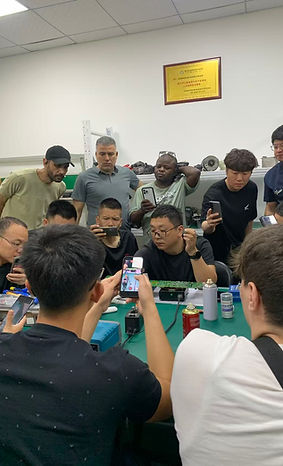
If you're starting from zero, structured training like our online EV & hybrid high-voltage repair course compresses the learning curve from months of trial-and-error into weeks of structured instruction, with over 100 deep-dive lessons covering battery balancing, EME data recovery, and OBC troubleshooting.
The Business Case: What One Successful Repair Is Worth
Let's run the numbers on a realistic month for a workshop that adds EV battery repair as a service line.
Service | Jobs/Month | Avg Revenue/Job | Monthly Revenue |
Battery diagnostics | 25 | $100 | $2,500 |
EV maintenance & inspection | 40 | $125 | $5,000 |
Module-level battery repair | 5 | $1,500 | $7,500 |
Total | $15,000 |
That's roughly $180,000 in annual revenue from a service line most shops haven't started. And module-level work — the highest-margin piece — accounts for half of it.
Profit margins on battery repair typically run 50–65%, significantly higher than general mechanical work, because you're selling diagnostic expertise, not just parts.
Compare that to what the shop loses today by referring the work out:
You collect nothing on a job that takes the dealership weeks to schedule
Your customer's EV goes somewhere else, and often doesn't come back for any future service
You absorb the reputational cost of "they couldn't help me"
One successful 48V battery recovery or EME data flash typically pays for the entire tooling investment and training course combined. After that, every repair is margin.
Frequently Asked Questions
Can an EV battery really be repaired instead of replaced?
Yes. Modern packs are modular systems composed of individual modules, contactors, sensors, cooling circuits, and management electronics. Faults in the BMS, a single module, contactors, or connectors can frequently be repaired individually without buying a new pack. Around 61% of quoted faults in 2026 data were resolved without full replacement.
How much can I save by repairing an EV battery module?
Targeted module or component repairs typically cost 600–3,500, compared to 10,000–20,000+ for a new OEM replacement pack. That's a 60–85% saving in eligible cases — and the reason customers seek out workshops that offer it.
How long does a repaired EV battery last?
When performed correctly — using healthy, capacity-matched, balanced replacement modules alongside tested contactors and updated BMS calibration — a repaired pack can reliably deliver tens of thousands of additional miles and several more years of service. Quality of parts matching matters enormously here; this is why we bench-test every module before it ships.
Does a small accident ruin an EV battery?
Not necessarily. Most modern EVs have impact sensors that trigger an emergency HV disconnect or pyrofuse activation to protect occupants. If the physical enclosure hasn't been deformed or breached, replacing the pyrofuse and clearing BMS crash data can often restore full functionality. Always check for structural intrusion before concluding the pack is safe to service.
Will using an independent shop void my battery warranty?
Generally, no. In the UK, EU, US and similar jurisdictions, using a competent independent technician for out-of-warranty work doesn't void a manufacturer's battery warranty on unrelated components. However, opening and repairing an in-warranty pack can void remaining coverage — always check warranty status first and direct in-warranty claims through the OEM.
What's the difference between a remanufactured pack and a new pack?
A remanufactured pack uses the original OEM enclosure and BMS hardware, refurbished and reflashed, with tested and capacity-matched cells replacing only what failed. It delivers OEM-level performance at 30–50% below the price of a new pack, typically with a 1–3 year warranty. A new pack is entirely fresh — cells, casing, and BMS — and carries the longest warranty.
What equipment do I need to start offering EV battery repair?
At minimum: a professional multi-brand EV diagnostic tablet with live BMS streaming, a CAT III/IV insulation resistance tester, a CAT III/IV HV multimeter, an active battery equalizer or module balancing bench, appropriate pack lifting equipment, and Class 0 (1000V) PPE. Realistic startup for a battery-focused service line is 20,000–50,000 depending on what you already own.
How do I know if a fault is repairable without opening the pack?
You often can't know without proper diagnosis. Request live BMS data — individual cell voltage deltas, isolation resistance, specific DTC codes. A module-level diagnosis typically takes around 2.4 hours and a few hundred in labor, and in 2026 data saved customers an average of £3,180 when they got a second opinion before accepting a replacement quote. That diagnostic fee is the cheapest insurance in the entire repair process.
The Bottom Line for Independent Workshops
The 2026 data makes one thing unambiguous: most of the EV battery work currently flowing to dealerships doesn't need to go there.
71.4% of dealer quotes are for full pack replacement. 11.8% of independent specialist quotes are. That's not a coincidence — it's a commercial model. Dealers are structured to replace assemblies. Independent shops are structured to diagnose, isolate, and repair.
The shops that win the next five years of EV work won't be the ones with the most equipment. They'll be the ones who can look at a "dead battery" and ask: which part of it actually failed?
Start with diagnostics. Get the training. Build the parts supply chain. And when the customer with the $14,000 dealership quote walks into your bay asking if there's another option — you'll be the shop that has one.
High-voltage electrical systems in hybrid and battery electric vehicles operate between 48V and 800V+ DC and carry severe risks of fatal electric shock, electrical arcing, and thermal events. All diagnostic, isolation, and repair procedures must be performed exclusively by qualified technicians equipped with certified Class 0 (1,000V) PPE and IEC 60900 insulated tools, following OEM service manuals and local safety regulations.
Ready to add EV battery repair to your workshop's service menu?
Shining EV supplies tested battery modules, SME/EME programmers, 48V system test platforms, and diagnostic equipment for Tesla, BMW, Mercedes-Benz, Porsche, Audi, Toyota/Lexus and Land Rover platforms — every unit bench-tested in our own Shenzhen workshop before shipping, with remote technical support on every order.



Comments